Emerson Innovation in HVAC Intelligence

Where IoT connectivity, artificial intelligence, and decades of thermal engineering expertise converge to reshape building climate management

IoT Platform

Cloud-Connected Building Intelligence

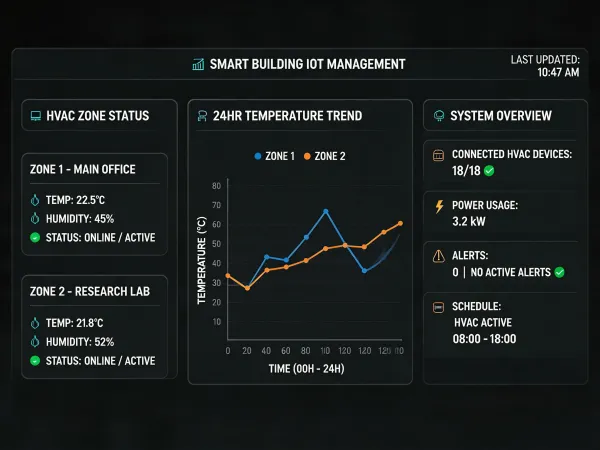
Every Emerson controller ships with embedded connectivity — MQTT, REST API, and cloud gateway support. Our platform aggregates data from thousands of control points across multiple facilities into a single operational dashboard.

Building managers gain real-time visibility into energy consumption patterns, equipment health metrics, and environmental compliance status — from any device, anywhere.

Protocol Support BACnet, Modbus, MQTT, REST, OPC-UA
Edge Computing On-device analytics with <100ms loop response
Cloud Platform AWS IoT / Azure IoT Hub compatible
IoT Building Platform
AI Analytics

Predictive Maintenance Powered by Machine Learning

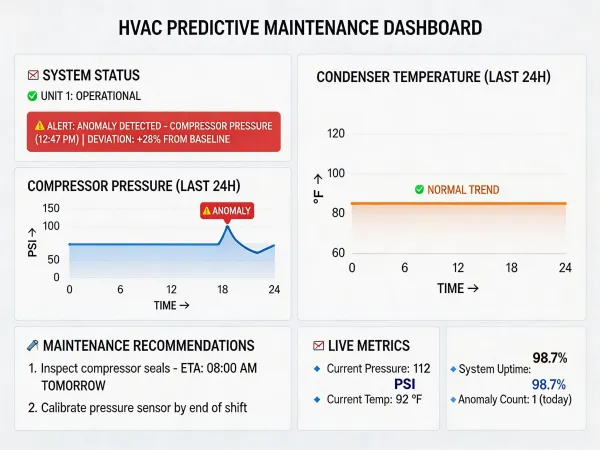
Our AI engine processes continuous data streams from vibration sensors, temperature probes, and power meters to identify equipment degradation weeks before failure occurs.

The system detects compressor bearing wear, expansion valve drift, sensor calibration deviation, and refrigerant charge loss — automatically generating prioritized maintenance work orders.

73% Unplanned Downtime Reduction
2.8x Mean Time Between Failures Improvement
15-25% Maintenance Cost Reduction
AI Predictive Maintenance
Refrigerant Transition

Control Algorithms for the Low-GWP Era

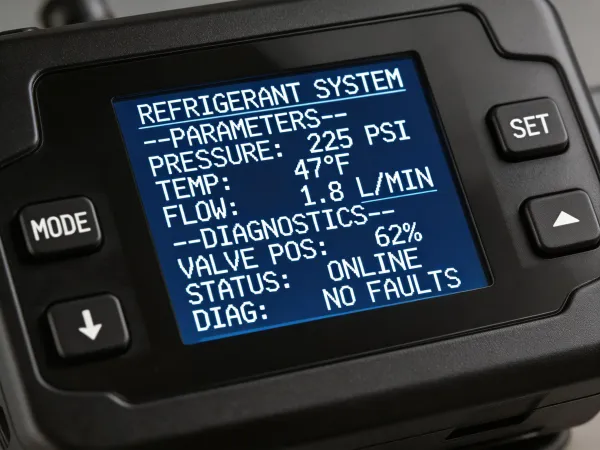
The global transition from high-GWP HFCs to natural and low-GWP synthetic refrigerants demands fundamentally different control strategies. R-290 (propane) systems require charge-minimized designs with explosion-proof rated controllers. CO2 transcritical systems operate at pressures exceeding 100 bar with narrow efficiency windows.

Emerson's next-generation EEV controllers and compressor management algorithms are purpose-built for these challenges — handling the unique thermodynamic properties of each refrigerant with optimized superheat control, oil return management, and safety interlock sequences.

  • R-290 (Propane) — Charge monitoring, leak detection integration, ATEX-rated controllers
  • R-744 (CO2) — Transcritical/subcritical mode switching, flash gas bypass control
  • R-32 — High-discharge temperature management, VFD coordination
  • R-1234ze — Low-pressure system optimization, centrifugal compressor surge control
Next-Gen Refrigerant Controls

Refrigerant Transition: Navigating the Trade-offs

The Kigali Amendment and EU F-Gas Regulation are forcing a global shift away from high-GWP HFCs. Two primary pathways have emerged, each with distinct engineering and economic implications.

Natural Refrigerants (CO2, NH3, R-290)

Zero or near-zero GWP with proven long-term sustainability. CO2 transcritical systems are increasingly viable even in warmer climates, and propane (R-290) charge-minimized designs are gaining traction in commercial refrigeration. No patent dependencies and lower operating costs at scale make naturals attractive for new installations. However, ammonia systems require strict safety infrastructure (ASHRAE 15 compliance, machine room ventilation), and R-290 flammability limits charge sizes to approximately 150g per circuit in many jurisdictions without additional mitigation measures.

Synthetic Low-GWP HFOs (R-1234yf, R-1234ze)

Drop-in or near-drop-in compatibility with existing HFC infrastructure reduces retrofit costs and accelerates adoption timelines. HFOs eliminate the flammability and toxicity concerns associated with natural refrigerants, making them suitable for technician workforces trained on traditional systems. The trade-off: higher refrigerant cost per kilogram, ongoing patent licensing from chemical manufacturers, and emerging concerns about PFAS persistence of HFO degradation byproducts (trifluoroacetic acid) in water systems — a regulatory area still under active review by the European Chemicals Agency.

Emerson's position: Our control platforms are refrigerant-agnostic by design. We provide validated control algorithms for both pathways because the optimal choice depends on application type, local regulations, site safety infrastructure, and total cost of ownership over the equipment lifecycle. Our engineering team helps facilities evaluate both options through detailed system modeling.

Variable Speed vs. Fixed Speed: Matching Controls to Load Profiles

Inverter-driven (variable frequency drive) compressors deliver 30-50% energy savings at part-load conditions and enable precise temperature control with soft-start capability that reduces mechanical stress. They are the preferred choice for variable-load applications such as data centers, commercial offices with fluctuating occupancy, and pharmaceutical facilities with changing process demands.

Fixed-speed compressors offer lower capital cost, simpler controls, easier maintenance, and proven reliability in constant-load applications. Industrial process cooling lines, ice-making plants, and continuous-operation cold storage facilities often see faster ROI with fixed-speed systems because the load profile remains relatively stable throughout the operating cycle.

The breakeven point depends on three factors: facility load profile variability, local electricity pricing (particularly demand charges and time-of-use rates), and expected equipment lifecycle. Our energy modeling service quantifies the payback period for each option using 8,760-hour annual load simulations based on actual facility data.

Selection Factor Variable Speed (VFD) Fixed Speed
Part-Load Efficiency 30-50% energy savings at 50% load Efficiency drops below rated COP at part load
Capital Cost 15-30% premium over fixed speed Lower upfront investment
Temperature Control ±0.3°C achievable ±1-2°C typical (on/off cycling)
Maintenance Complexity VFD drive board replacement, harmonic filtering Standard contactor/starter maintenance
Ideal Application Variable occupancy, multi-zone, data centers Constant load, process cooling, ice production

Partner With Our R&D Team

Collaborate with 65 engineers on custom control solutions, OEM integration projects, and building automation research

Start a Conversation